How to Choose Learning Toys for Global Buyers in 2026?
Choosing Learning Toys for global markets in 2026 means looking beyond bright colors and polished packaging. Buyers need to ask what children can actually do with each toy. Can a child sort wooden shapes, test a simple cause-and-effect mechanism, or build a new structure after several attempts? These small interactions reveal more than a broad “educational” label. Age guidance, durable materials, clear instructions, and accessible design also matter. So does the destination market: buyers should verify current product and labeling requirements with qualified local sources.
Dr. Maria Montessori, the physician and education pioneer whose ideas continue to influence learning-toy design, is often credited with the phrase, “Play is the work of the child.” It is a useful reminder, not a complete buying rule. A toy can invite play and still frustrate children if its pieces are too small, its instructions unclear, or its challenge poorly matched to their age. Details count.
This guide will help global buyers compare learning goals, construction, safety documentation, supplier reliability, and market fit. It will also consider practical issues such as packaging space, replacement parts, and language needs. Ask suppliers for test reports and traceable product information, then check that documentation against the intended destination. No checklist catches every mismatch. A sample in a child’s hands may expose problems that a catalog cannot. That is worth remembering.
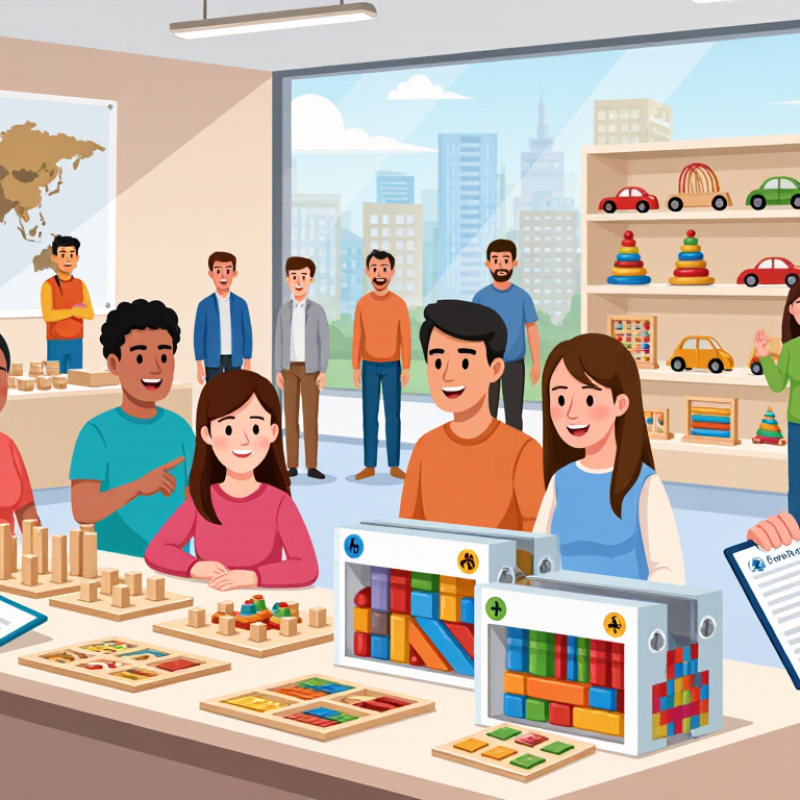
Define Learning Goals and Age-Appropriate Skills
Before comparing learning toys, define the skill a child should practice. “Builds problem-solving” is too broad to guide a purchase. A clearer goal might be matching five shapes, sorting objects by color, or following a two-step sequence. These actions are easier to assess during play.
Match the task to the child’s age and current abilities, not just the age printed on a package. Younger children may benefit from large pieces, simple cause-and-effect play, and short activities. Preschoolers can often practice counting, pattern-making, and taking turns. Older children may enjoy open-ended construction or beginner logic challenges. Children develop at different speeds. That matters. For global buyers, favor toys with clear visual instructions and activities that do not depend on spoken language. Check that materials, piece sizes, and age guidance suit the intended market and user group. Observe a sample session: can a child start with little help, stay engaged, and try a new step? If the toy is either frustrating or instantly mastered, the learning goal may need adjusting. Even a tidy age chart cannot tell the whole story.
Evaluate Educational Value, Playability, and Inclusiveness
How to Choose Learning Toys for Global Buyers in 2026?
Evaluate Educational Value, Playability, and Inclusiveness
For global buyers in 2026, assess what children can learn, do, and access—not just the feature list. A 2022 systematic review in Child Development examined 39 studies of guided play. It found advantages over direct instruction for early mathematics and shape knowledge. The reported effect sizes were 0.24 and 0.63, respectively. These findings support guided exploration, not a promise that any toy improves achievement. Check whether children can sort, build, tell stories, or solve problems with it.
Playability matters. Can children begin without lengthy instructions? Do pieces withstand repeated handling, and can the game change after the first round? A fixed sequence may teach a skill but lose its appeal quickly. Watch real play. Note where children pause, improvise, or ask for help. UNICEF’s 2021 report Seen, Counted, Included estimates that 240 million children worldwide have disabilities. Look for easy-grip pieces, clear contrast, tactile cues, and multiple ways to participate. No single design fits everyone.
Tips: Request play observations with children in the intended age range, not only lab claims. Compare instructions, parts, and sensory demands across languages and abilities. Ask whether children with different motor, vision, hearing, or communication needs can join. Record shortcomings, too; a confusing symbol can exclude a child.
Verify Safety Standards and Market-Specific Compliance
How to Choose Learning Toys for Global Buyers in 2026?
Verify Safety Standards and Market-Specific Compliance
A learning toy can look safe on a sample table and still fail a market’s rules. Check the finished product, packaging, age grading, and test reports for each destination. The European Commission’s 2023 Safety Gate report recorded 3,412 consumer-product alerts; toys were among the repeatedly flagged categories. That is a useful warning, not a prediction that every toy carries the same risk. Inspect small parts, cords, coatings, and battery compartments, especially on toys intended for young children. Paperwork matters.
Tips: Match evidence to the sales market. In the United States, confirm applicable requirements, including ASTM F963 and CPSIA obligations. For the EU, check relevant EN 71 requirements and current toy-safety rules. Ask suppliers for reports tied to the exact model, materials, and factory—not a similar product. Verify that labels and warnings use the required language and format.
A certificate alone is not a full safety review. Compare the test scope with the toy’s actual features, then confirm requirements with a qualified testing or compliance professional. Rules and enforcement can change, and requirements differ between markets. The awkward part: a late packaging change can make earlier evidence incomplete. Keep dated documents, approved artwork, and sample records together before placing a large order.
Assess Suppliers, Pricing, and Global Logistics
Choosing learning toys for global buyers in 2026 requires more than comparing supplier quotations. Buyers should inspect factory experience, material traceability, testing records, and production capacity. Request a sample from the actual production line, not a showroom sample. A supplier’s quality process matters when small parts, batteries, or repeated classroom use are involved. The 2023 World Bank Logistics Performance Index evaluates 139 economies across customs, infrastructure, shipment tracking, and delivery reliability. Use these indicators when comparing manufacturing locations and transport routes.
Tips: Build a landed-cost sheet. Include tooling, packaging, inspections, duties, insurance, and storage. Ask suppliers for carton dimensions and gross weight early. A low unit price can become expensive after dimensional freight charges. Require written lead times, but leave safety stock for port delays. I would also score suppliers quarterly, because a strong first shipment proves very little.
UNCTAD’s Review of Maritime Transport 2024 highlights continuing exposure to route disruptions and higher shipping uncertainty. Therefore, avoid depending on one port or one carrier. Compare ocean, rail, and air options for urgent replenishment. Choose packaging that protects puzzle pieces and counting blocks without wasting space. Digital tracking improves visibility, but it does not replace physical inspections. My own bias is to prefer the cheapest verified route; that can be a mistake. A slightly higher freight cost may protect a seasonal launch. Recheck assumptions with real invoices after every shipment.
How to Choose Learning Toys for Global Buyers in 2026?
Supplier screening, pricing validation, and global logistics planning
The chart uses the World Bank’s 2023 Logistics Performance Index scores as a country-level logistics benchmark. Higher scores indicate stronger customs, infrastructure, shipment, logistics-competence, and delivery-timeliness performance. Buyers should combine this benchmark with supplier audits, toy-safety documentation, landed-cost quotations, minimum-order quantities, and delivery-time commitments before selecting a supplier.
Source: World Bank, Logistics Performance Index 2023 — lpi.worldbank.org